
French Citizenship by Descent - How to Get It Through Ancestry in 2026
If you have French roots, you may be wondering whether you can claim French citizenship through your family. This guide explains how French citizenship by descent works, who is eligible, and how to apply based on your ancestry.
🇫🇷 Based in France & UK • 10+ Years of Legal Experience • Multilingual Team
French Citizenship by Descent Guidance
We help you understand french citizenship by descent and assess your eligibility based on your family background.
How to Get French Citizenship by Descent
Our legal team guides you on how to get french citizenship by descent with a clear, step-by-step approach.
Apply for French Citizenship by Descent
Apply for french citizenship by descent with professional support to avoid delays, errors, or rejection.
French Ancestry Citizenship Support
We review your french ancestry citizenship case and help determine if you qualify under French law.
French Citizenship by Ancestry
Get clarity on french citizenship by ancestry and how it relates to descent with expert legal insight.
French Dual Citizenship by Descent
We help you explore french dual citizenship by descent and understand your rights while keeping your current nationality.

Key Takeaways
- A direct parent link is usually required for french citizenship by descent.
- This route is exempt from the 2026 B2 language and civic exam rules.
- The process usually takes 12–24 months depending on your documents.
French Citizenship by Descent and Ancestry Explained
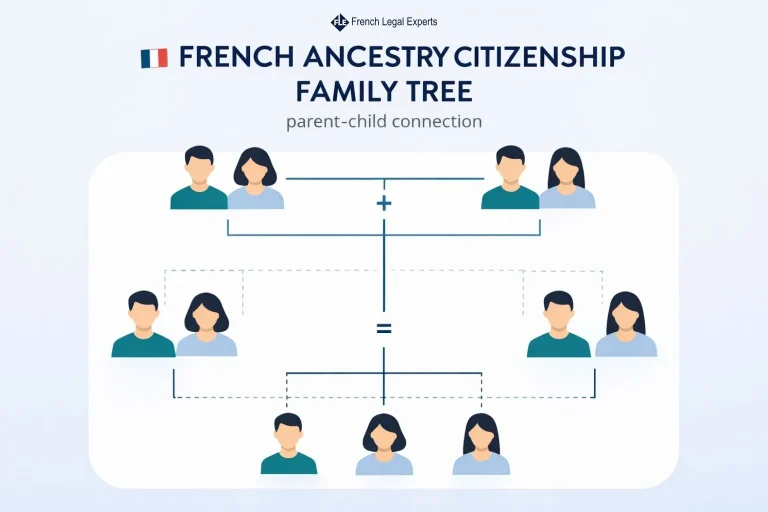
If you have French roots, you might be wondering if you can become a French citizen through your family. In simple terms, this is called citizenship by descent. It means that nationality can pass from parent to child.
Many people use terms like ancestry or family origin when talking about this topic. While those ideas are related, French law mainly looks at whether your parent was legally a French citizen at the time of your birth. This is the key factor that decides your eligibility.
In most cases, having a French parent is what allows you to claim citizenship. Distant family history alone is usually not enough without a clear legal link.
This is why understanding your family records is so important. Documents such as birth certificates, marriage records, and proof of nationality help show the connection between you and your French parent.
If your situation is not clear, getting proper legal guidance can make a big difference. A small mistake or missing document can delay or even stop your application. If you need support, you can also consult with a dedicated French citizenship lawyer to review your case and avoid mistakes.
The good news is that if you meet the legal conditions, you may be able to hold French nationality along with your current citizenship. This can open doors to living, working, and studying in France and across Europe.
Can You Get French Citizenship Through Ancestry?
Many people believe that having French ancestors is enough to become a citizen. It sounds simple, but the reality is a bit more detailed. French law looks for a clear and direct legal connection.
It Depends on Your Parent
In most cases, citizenship is passed from a parent to a child. If your parent was a French citizen at the time of your birth, you may have a strong case.
Not Just Family History
Having a French grandparent or distant ancestor alone is usually not enough. There must be a legal link that connects you directly to French nationality.
Documents Matter
You will need proper records to prove your connection. This includes birth certificates, family records, and proof of nationality.
Simple Way to Understand It
- ✔ A direct link to a French parent is usually required
- ✔ Legal proof is more important than family stories
- ✔ Each case is reviewed based on official records
Because every situation is different, it is common for people to feel unsure about their eligibility. Even small gaps in documents or timing can change the outcome.
If you are not fully certain about your case, getting a professional review can help you understand your options clearly before starting the process.
French Citizenship by Descent Eligibility and Rules
To understand if you qualify, it is important to follow the basic legal rules. These rules are simple in idea, but each case depends on proper proof and timing.
1. Citizenship Comes from a Parent
The most important rule is that citizenship is usually passed from a parent to a child. If one of your parents was a French citizen when you were born, you may already have a valid claim.
2. Status at the Time of Birth
What matters most is your parent’s legal status at the time of your birth. If they were not recognized as a citizen at that time, your case may become more complex.
3. Continuous Legal Connection
There must be a clear and continuous link between you and your French parent. This connection must be supported by official documents without gaps.
4. Proper Documentation
You will need birth certificates, family records, and proof of nationality. Missing or incorrect documents can lead to delays or rejection.
How Eligibility is Reviewed
Check your parent’s citizenship status
Verify your birth and family records
Confirm the legal connection without gaps
Prepare documents for official review
Many people feel confident at first but later discover missing details in their records. This is why careful review is important before starting any application.
If you are unsure about your eligibility, a professional assessment can help you understand your chances and avoid costly mistakes.
Why 2026 is the Best Time to Claim Ancestry Citizenship
In 2026, France introduced stricter rules for many citizenship pathways. But if you qualify through french citizenship by descent, these rules do not apply to you.
Big Advantage for Ancestry-Based Applicants
If you are applying through french ancestry citizenship, you are exempt from many new requirements that affect other applicants.
Other Citizenship Paths
- B2 French language test required
- 40-question civic exam required
- Proof of residence in France needed
- Longer and more complex process
Citizenship by Descent
- No language test required
- No civic exam required
- No residency requirement
- Based on your legal family connection
Why This Matters for You
Many people delay their plans because they worry about language tests or exams. But when you apply for french citizenship by descent, these barriers do not exist.
This makes it one of the simplest and most direct ways to become a French citizen if you have the right family connection.
Understanding how to get french citizenship by descent is important now more than ever. While other routes are becoming harder, descent remains clear and accessible.
If you qualify, you can move forward without worrying about tests, exams, or living in France first.
Many applicants exploring french citizenship by ancestry are surprised to learn this advantage. While other paths require years of preparation, descent focuses only on your legal connection.
This is why more people are now choosing to apply for french citizenship by descent instead of going through longer and more complex routes.
The process still requires proper documents and preparation, but it avoids the biggest barriers that stop many applicants in other pathways.
If you are eligible, this is one of the best opportunities to secure your status without additional requirements that apply elsewhere.
How to Apply for French Citizenship by Descent
If you believe you qualify, the next step is to start your application. The process may look simple at first, but each step must be done carefully to avoid delays.
Many people ask how to apply for french citizenship by descent or where to begin. The process depends on your situation, but the steps are usually similar.
Check Your Eligibility
Before you apply for french citizenship by descent, confirm that you meet the legal conditions. This includes checking your parent’s status and your family connection.
Gather All Documents
Collect all required documents such as birth certificates, proof of nationality, and family records. In many cases, this includes obtaining a certified French birth certificate to properly prove your lineage. These documents must match correctly without errors.
Prepare Your File
Your application must be properly prepared with translations, certified documents, and correct formatting as required by French authorities.
Submit Your Application
Submit your application through the correct authority or consulate depending on where you live.
Wait for Review
After submission, your case will be reviewed carefully. You may be asked for additional documents or clarifications during this stage.
Receive Decision
If your file is complete and correct, you will receive confirmation. If not, your application may be delayed or refused.
Common Challenges During the Process
Applying is not just about filling forms. Many applicants face issues that slow down or stop their case.
- Incorrect or missing documents
- Translation mistakes
- Incomplete family records
- Delays from authorities
Even small errors can create big problems. This is why careful preparation is important from the start.
Need Help With Your Application?
We help you apply for french citizenship by descent by reviewing your case, preparing your documents, and guiding you step by step. Our team works to reduce delays, avoid errors, and improve your chances of approval.
Get Your Case ReviewedThe CNF (Certificat de Nationalité Française): Your Final Proof of Citizenship
When you apply for french citizenship by descent, the final goal is not just approval. It is obtaining an official document called the CNF.
What is the CNF?
The Certificat de Nationalité Française (CNF) is the official proof that you are recognized as a French citizen. Without this document, you cannot apply for a French passport or fully confirm your nationality.
For official details, you can refer to the Official French Government Guide to the CNF , which explains the process and required documents.
Why the CNF is So Important
Many people focus only on how to get french citizenship by descent, but the CNF is the final step that confirms your status. It is issued by French courts after reviewing your case in detail.
Whether you are applying through french ancestry citizenship or exploring french citizenship by ancestry, your application must meet strict legal standards.
Court-Level Review
Your application is examined by legal authorities, not just processed as a simple request.
Strict Documentation
Every document must be complete, accurate, and properly certified.
No Room for Errors
Even a small mistake can lead to delays or rejection of your case.
Common Reasons for Rejection
When you apply for french citizenship by descent, many applications are delayed due to avoidable errors.
- Missing apostille on official documents
- Uncertified or incorrect translations
- Incomplete family records
- Inconsistencies in names or dates
The process of apply for french citizenship by descent is not just about eligibility. It is about presenting a complete and legally strong case.
This is why preparing your file carefully is essential before submission. A well-prepared application improves your chances of obtaining the CNF without delays.
Understanding the full process, from eligibility to final certification, helps you move forward with confidence.
Processing Times for Citizenship by Descent
One of the most common questions is how long the process takes. The answer depends on your case, your documents, and how complete your application is.
The French citizenship application timeline can vary from case to case. Some applications move faster, while others take more time depending on complexity.
Simple Cases
If your documents are complete and your family connection is clear, the process is usually smoother and takes less time.
Moderate Cases
Cases with missing records or additional verification may take longer due to extra checks by authorities.
Complex Cases
If your case involves multiple generations, missing documents, or legal issues, the process can take significantly more time.
What Affects Processing Time?
- Completeness of your documents
- Accuracy of translations and records
- Clarity of your family connection
- Response time from authorities
Many delays happen because of small mistakes or missing details. This is why preparing your file properly from the beginning can make a big difference.
If you are planning to apply for french citizenship by descent, understanding the timeline early helps you set the right expectations and avoid unnecessary delays.
Taking the time to prepare correctly can save months of waiting later.
How to Claim or Obtain French Citizenship by Descent
Many people are confused about whether they need to apply, claim, or obtain citizenship. These words may sound similar, but they are used in different situations.
What Does “Claiming” Citizenship Mean?
Claiming means that you already have the right to citizenship, but it has not been officially recognized yet. This usually happens when your parent was a citizen, but your status was never confirmed in records.
In this case, you are not asking for new citizenship. You are proving that you already have it through your family.
What Does “Obtaining” Citizenship Mean?
Obtaining citizenship means going through a formal process to get recognized. This involves preparing documents, submitting your case, and waiting for approval.
Even if you have the right through your ancestry, you still need to complete this process properly.
Simple Way to Understand
If you already qualify through your family, you are claiming your right. If your status is not confirmed yet, you must obtain recognition through the correct process.
How the Process Works in Real Life
In most cases, people need to go through both steps. First, they confirm their eligibility. Then they prepare documents and submit their case to be officially recognized.
This is why understanding how to get french citizenship by descent is important. It is not just about eligibility, but also about proving your case correctly.
Many people believe that having a French ancestor is enough. But without proper records and legal proof, the process cannot move forward.
Step 1: Confirm Your Right
Check if your parent was a citizen and if your connection is valid.
Step 2: Build Your File
Collect documents that clearly show your family link.
Step 3: Submit for Recognition
Present your case to the correct authority for review.
Step 4: Wait for Approval
Your case will be checked before a final decision is made.
The process of claiming french citizenship by descent can take time. Each case is reviewed carefully, and authorities may ask for more documents.
This is why applying for french citizenship by descent without proper preparation can lead to delays. Many applicants face issues due to missing or incorrect information.
Whether you are starting with french ancestry citizenship or trying to understand french citizenship by ancestry, the key is to follow the legal process step by step.
A well-prepared case improves your chances and helps you avoid unnecessary problems during review.
French Citizenship by Ancestry Application Explained
Many people search for a french citizenship by ancestry application, expecting a separate process. This is one of the most common misunderstandings.
No Separate Ancestry Application Exists
There is no official program or special application based only on ancestry. All cases are handled under the same legal system.
What This Means for You
Even if you have French ancestry, your case will still be reviewed under citizenship by descent. The law focuses on a direct and proven connection, not just family history.
This is why understanding how to get french citizenship by descent is important before you begin.
❌ Myth
There is a special french citizenship by ancestry application.
✔ Reality
All applications follow the same legal process based on descent.
❌ Myth
Any distant ancestor is enough to qualify.
✔ Reality
A clear legal connection to a parent is usually required.
Why This Confusion Happens
Many websites use terms like french ancestry citizenship or french citizenship by ancestry, which makes it sound like a separate process exists.
In reality, these are informal terms. The legal process remains the same.
What You Should Do Instead
Instead of looking for a different application, focus on preparing your case correctly. This includes checking your eligibility, collecting documents, and following the right steps.
When you apply for french citizenship by descent, your case will be reviewed based on legal proof, not just family claims.
Many applicants begin their journey with the idea of french citizenship by ancestry, but later understand that the process is more structured.
Knowing this early can save time and help you avoid mistakes. It allows you to prepare properly and move forward with confidence.
A clear understanding of the process is one of the most important steps in successfully obtaining recognition.
Can You Get French Citizenship by Descent Through Grandparents or Great Grandparents?
Many people ask if they can get citizenship through a grandparent or even a great grandparent. This is one of the most common questions, and it is important to understand the correct answer.
The Short Answer
In most cases, you cannot qualify based only on a grandparent or distant ancestor. The law usually requires a direct connection through a parent.
Why Grandparents Alone Are Not Enough
Even if your grandparent was a French citizen, this does not automatically mean you qualify. The key question is whether your parent also held citizenship and passed it on to you.
Without this direct link, your case may not meet the legal conditions required.
How the Legal Link Works
Grandparent was a French citizen
Parent must have received citizenship
Parent must pass it to you at birth
If the chain is broken at any step, the right to citizenship may not pass forward.
Grandparent Case
A grandparent alone is not enough unless your parent also held citizenship.
Great Grandparent Case
Cases involving great grandparents are more complex and usually do not qualify without strong proof.
Missing Records
If documents are missing, it becomes harder to prove your connection.
Legal Proof
Official records are required to confirm your family link.
Many people begin their search with french ancestry citizenship and believe that having any French ancestor is enough. But the legal process is more strict.
To understand how to get french citizenship by descent, you must focus on the direct connection between you and your parent. This is what authorities review carefully.
When you apply for french citizenship by descent, your case is checked step by step. Each generation must be clearly linked with proper documents.
This is why french citizenship by ancestry can sometimes be misunderstood. It sounds simple, but it still follows the same legal rules.
In some rare situations, complex cases may still be reviewed. But these require strong documentation and detailed legal analysis.
If you are unsure, it is always better to review your case properly before starting the process. This helps you avoid wasted time and effort.
The 50-Year Rule: Article 30-3 of the French Civil Code
Even if you believe you qualify through your family, there is an important legal rule that can affect your case. This is known as Article 30-3 of the French Civil Code.
If a French ancestor lived outside France for 50 consecutive years without maintaining legal ties, their French nationality may have been lost.
What Does This Mean in Simple Terms?
French citizenship is not always passed down automatically forever. If your ancestor moved abroad and did not maintain their connection with France, their nationality may no longer be valid for transmission.
This rule is based on Article 18 of the French Civil Code and related provisions governing nationality and loss of rights.This is why understanding french citizenship by descent requires more than just knowing your family history. Legal status must also be confirmed.
What Counts as Legal Ties?
Renewing a French passport, voting in French elections, or maintaining official records can help show continued connection to France.
What Happens If Ties Are Broken?
If no legal connection is maintained for 50 years, the right to citizenship may be lost and cannot be passed to future generations.
Why This Rule Matters
Many applicants discover this issue only after starting their application. It can affect eligibility even if your ancestry seems clear.
When you apply for french citizenship by descent, this rule is often reviewed as part of your case. This is why proper legal analysis is important before moving forward.
If you are exploring french ancestry citizenship or trying to understand how to get french citizenship by descent, this rule can play a key role in your eligibility.
Each case is different, and even small details in your family history can change the outcome. Reviewing your situation carefully can help you avoid problems later in the process.
Frequently Asked Questions About French Citizenship by Descent and Ancestry
Yes, you can get French citizenship by descent if one of your parents was a French citizen at the time of your birth. You must also prove this connection with official documents.
You may qualify through ancestry, but only if there is a direct legal link. In most cases, this means your parent must have been a French citizen.
To get French citizenship by descent, you need to confirm your eligibility, gather documents, and submit your case for official recognition. The process depends on your personal situation.
You apply by preparing a complete file with proof of your family connection and submitting it to the relevant authority or consulate. Proper documentation is very important.
In most cases, a grandparent alone is not enough. Your parent must also have held French citizenship and passed it to you.
No, there is no separate ancestry application. All cases are handled under citizenship by descent.
The timeline can vary. Some cases are processed in a few months, while others may take longer depending on documents and complexity.
Yes, France allows dual citizenship. You can keep your current nationality while becoming a French citizen.
You usually need birth certificates, proof of your parent’s citizenship, and documents that show your family connection.
If you are unsure, it is best to review your case carefully before applying. Missing details or incorrect documents can cause delays.
Not Eligible by Ancestry? You Still Have Options
If you are not eligible for citizenship through your family, it does not mean your journey ends here.
Many applicants discover that they do not meet the legal requirements for descent after reviewing their case. This can happen due to missing records, broken lineage, or rules like the 50-year limitation.
The good news is that there are other legal pathways available depending on your situation.
One of the most common alternatives is French citizenship by marriage, which allows you to apply if you are married to a French citizen and meet certain conditions.
This route follows a different process but can still lead to full French nationality. Exploring all available options helps you move forward with confidence, even if ancestry is not the right path.
Speak with a French Lawyer About Your Citizenship by Descent
We help clients understand and apply for french citizenship by descent with clear legal guidance. Whether you are exploring french ancestry citizenship or looking to apply for french citizenship by descent, our team reviews your case, prepares your documents, and guides you through every step with complete legal support. If you want deeper guidance, you can also consult with a dedicated French citizenship lawyer before starting your application.
Get Your Case ReviewedWhy 2026 is the Best Time to Claim Ancestry Citizenship
In 2026, France introduced stricter rules for many citizenship pathways. But if you qualify through french citizenship by descent, these rules do not apply to you.
Big Advantage for Ancestry-Based Applicants
If you are applying through french ancestry citizenship, you are exempt from many new requirements that affect other applicants.
Other Citizenship Paths
- B2 French language test required
- 40-question civic exam required
- Proof of residence in France needed
- Longer and more complex process
Citizenship by Descent
- No language test required
- No civic exam required
- No residency requirement
- Based on your legal family connection
Why This Matters for You
Many people delay their plans because they worry about language tests or exams. But when you apply for french citizenship by descent, these barriers do not exist.
This makes it one of the simplest and most direct ways to become a French citizen if you have the right family connection.
Understanding how to get french citizenship by descent is important now more than ever. While other routes are becoming harder, descent remains clear and accessible.
If you qualify, you can move forward without worrying about tests, exams, or living in France first.
Many applicants exploring french citizenship by ancestry are surprised to learn this advantage. While other paths require years of preparation, descent focuses only on your legal connection.
This is why more people are now choosing to apply for french citizenship by descent instead of going through longer and more complex routes.
The process still requires proper documents and preparation, but it avoids the biggest barriers that stop many applicants in other pathways.
If you are eligible, this is one of the best opportunities to secure your status without additional requirements that apply elsewhere.